
How Google AI Overview is changing the search Game. Or is it?
As the year comes to a close, you might find yourself lamenting your organic traffic performance. If it’s any consolation to you and your business, no one gets to say goodbye to 2024 without also saying goodbye to some of their organic website traffic. The reality is that AI, specifically Google AI overview, has absolutely changed the way people search and engage with brands—this goes for B2B and B2C brands. According to a recent article on Search Engine Land, Google’s AI Overview has led to an organic traffic drop of anywhere between 18% and 64%. The search game has undoubtedly transformed since Google rolled out its AI Overview— and it’s evolving the way businesses and marketers approach content marketing and SEO.
That said, the game hasn’t changed that much.
However, change is scary and it’s especially worrisome when change occurs with immense velocity, which AI has a tremendous aptitude for. So, what has changed exactly?
Google AI Overview: What it is
According to Google, AI Overviews appear in one’s Google Search results when Google’s systems determine that generative AI can be especially helpful like when someone wants to quickly understand information from a range of sources, for instance.
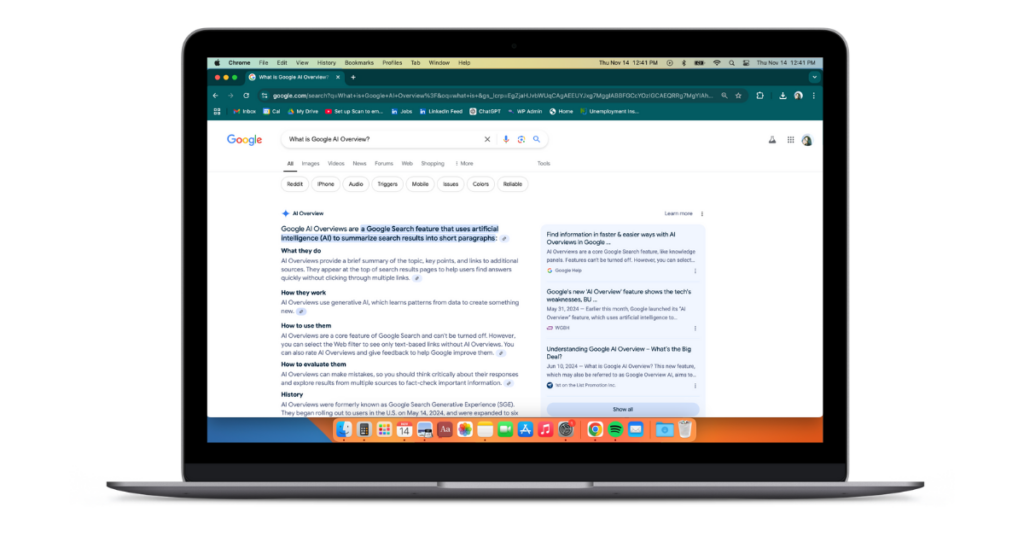
What you’ll also note about Google AI Overview is that beside each response, Google provides a link to where the information was sourced so you can visit the website for more information.
On its support page, Google goes on to explain that AI Overviews use generative AI, which is a rapidly evolving technology, “and may provide inaccurate or offensive information. AI overview can and will make mistakes.”
Google AI Overview: What it isn’t
Now that we’ve established what Google AI Overview is, it’s important to also look at what it isn’t. By looking at its definition, we can say then, that Google AI Overview is:
- Not a source for in depth and detailed information: Those searching for more in-depth information will need to engage with web links and websites for more.
- Not 100% reliable: Which means that for important matters like those relating to Your Money or Your Life, it’s likely best to go beyond a cursory overview, and dive in deeper on a matter and fact-check information
- Not a static technology: Marketers need to be aware that changes will be rolled out as needed, maybe regularly until the technology is fine tuned. This means regularly navigating change.
While many may have been worried that AI was coming for our jobs, the reality is that there is still plenty of work that requires human talent. AI is not your magic bullet to your SEO and content marketing needs.
The new rules of the game
So, what do these changes mean for marketers? Should you throw out your entire SEO strategy? Should you no longer bother with search engine rankings anymore?
Well, the new rules of the game are actually…the old rules of the game. At least mostly. Google AI Overview definitely changes the landscape of search, but it doesn’t mean that the end is nigh for search as we know it. The search game has become harder, without a doubt. Smaller companies and startups will have to work harder to gain visibility and drive awareness via organic search. However, difficult does not mean impossible. If anything, Google AI Overview is an opportunity for marketers to double down on old principles centered on delivering value to audiences.
Let’s take a closer look.
Informational content is important, but in-depth content is clutch
With Google providing an AI overview to queries, this means that audiences are less likely to visit websites for more informational answers to their questions. And we’ve seen this shift already with decreases in organic traffic to websites. However, as Google rolls out new features, and people realize that the AI Overviews aren’t always accurate, we’ll see some fluctuations in engagement with website and organic traffic.
Furthermore, SERP features haven’t disappeared. It’s important to remember that while AI Overviews are hot right now Google AI Overviews only show for 7% of queries and SERP features and AI Overviews often appear together. This makes sense because SERP featured snippets mostly appear on informational queries. With this in mind, it is important that marketers continue to implement a thoughtful keyword strategy and leverage keyword optimized content.

Moreover, developing content that dives deeper into a topic that showcases expertise is critical to engaging audiences via organic search. Your content goal should be to focus on how you deepen your connection with your audience by delivering unique expertise they can’t get anywhere else. Which leads me to our next point…
Experience: A unique differentiator in SEO
On December 15, 2022, Google’s quality rater guidelines evolved to introduce an additional E, to E-A-T. This transformed the guideline to focus on experience, expertise, authoritativeness, and trustworthiness. What’s specifically interesting about adding expertise to the guideline is that expertise is a way of evaluating the reputation of websites and content contributors, because expertise on a subject relies largely on first-hand experience. And first-hand experience is something artificial intelligence can’t have. Wow, it’s almost as if Google knew it would be rolling out Google AI Overview 18 months later or something. Amazing.
So, what does this mean in terms of practical SEO application?
The reputation of the people contributing to the content on the actual pages factors into how websites are evaluated. Furthermore, Google has indicated that for most pages, the quality of the main content (MC) can be determined by the amount of effort, originality, and talent or skill that went into the creation of the content. What’s more original than your own unique, first-hand experience with and perspective on something?
Google goes on to also describe how originality is also evaluated by “the extent to which content offers unique, original content that is not available on other websites. If other websites have similar content, consider whether the page is the original source.” In other words, Google is really encouraging marketers to think outside the box, and find new and creative ways to engage audiences, showcase unique expertise, and deliver value—and some of this calls for reputation building.
Reputation matters: Influencers are not just for B2C businesses
Building a reputation is what marketers do, right? Yes, but unfortunately I’m not talking about the brand’s reputation. I’m talking about the reputation of the content contributors. Google now evaluates content based on the reputation of the person contributing the content.
Influencers are a critical component to marketing a business—even those that are B2B. For those CEOs, CROs, CMOs, and other C-level executives who have put off developing their digital personas, who have ignored the pleas of their marketing teams to be active on LinkedIn and to develop their own POVs on industry topics: You can no longer hide. The time has come to dust off your LinkedIn profile and start building your reputation, loudly.
Reputation is something that cannot be established in a vacuum. It needs to be perceived by another party to exist. Which is why it’s critical that leaders and subject matter experts take the time to develop a reputation by cultivating opinions and perspectives that provide their unique take on industry matters and that others can engage with.
Quality over Quantity: Avoid the AI-content-farm trap
With the advent of tools like ChatGPT, Perplexity, or Claude, marketing teams may be tempted to start churning out loads of content for their prospects and clients. The problem is that:
- If you’re spinning content out via AI, without taking time to edit, personalize, and provide unique perspectives lensed through your company’s experience and expertise, or that of a subject matter expert, it’s difficult to build trust and authority through your content
- Leveraging AI, without solid strategy or governance in place, will result in spammy, duplicative content across websites
- Google is reducing its crawl budget for websites that have higher content velocity to their trust rating. You will inevitably lose visibility
So, what’s a marketer to do?
The name of the game is trust
As I mentioned at the start of this post, Google AI overview doesn’t mean that the end is nigh for SEO and organic search. What it means is an opportunity to double down on principles centered on creating trust. In other words, don’t be shady.
Instead focus on how to:
- Be helpful: Ask yourself how can you make your audience’s lives easier by way of content? What can you do to alleviate or remove some of the headache from their lives?
- Go deep, not wide: Instead of creating tons of content that only grazes the surface of a subject, focus on a few key topics that are important to your audience and really dive into them, exploring specifics, use cases, case studies, perspectives, etc. This will help you focus on quality vs quantity.
- Be unique: Tap into the big brains at your organization to showcase unique perspectives and insights that other organizations don’t have. Even if your competition does share some of the same perspectives, that’s OK. Focus on building reputation and how to deliver those perspectives in a unique way.
- Be community minded: Building your reputation means connecting with your community. For B2B businesses that means finding more opportunities for partner marketing, co-authored research, leaning on your happy customers to become brand champions, and investing in building your presence on social media channels like LinkedIn.
The introduction of Google’s AI Overview isn’t just another algorithm update – it’s a fundamental shift in how search serves users. However, this change reinforces rather than revolutionizes the core principles of effective digital marketing. Success still hinges on providing genuine value, showcasing real expertise, and building authentic connections with your audience.
The key isn’t to fight against AI Overview but to adapt your strategy to complement it. By focusing on what AI can’t replicate – your unique experiences, insights, and expertise – you’ll continue to find success in organic search, even as the landscape evolves. That’s your secret sauce in your new era of search.

